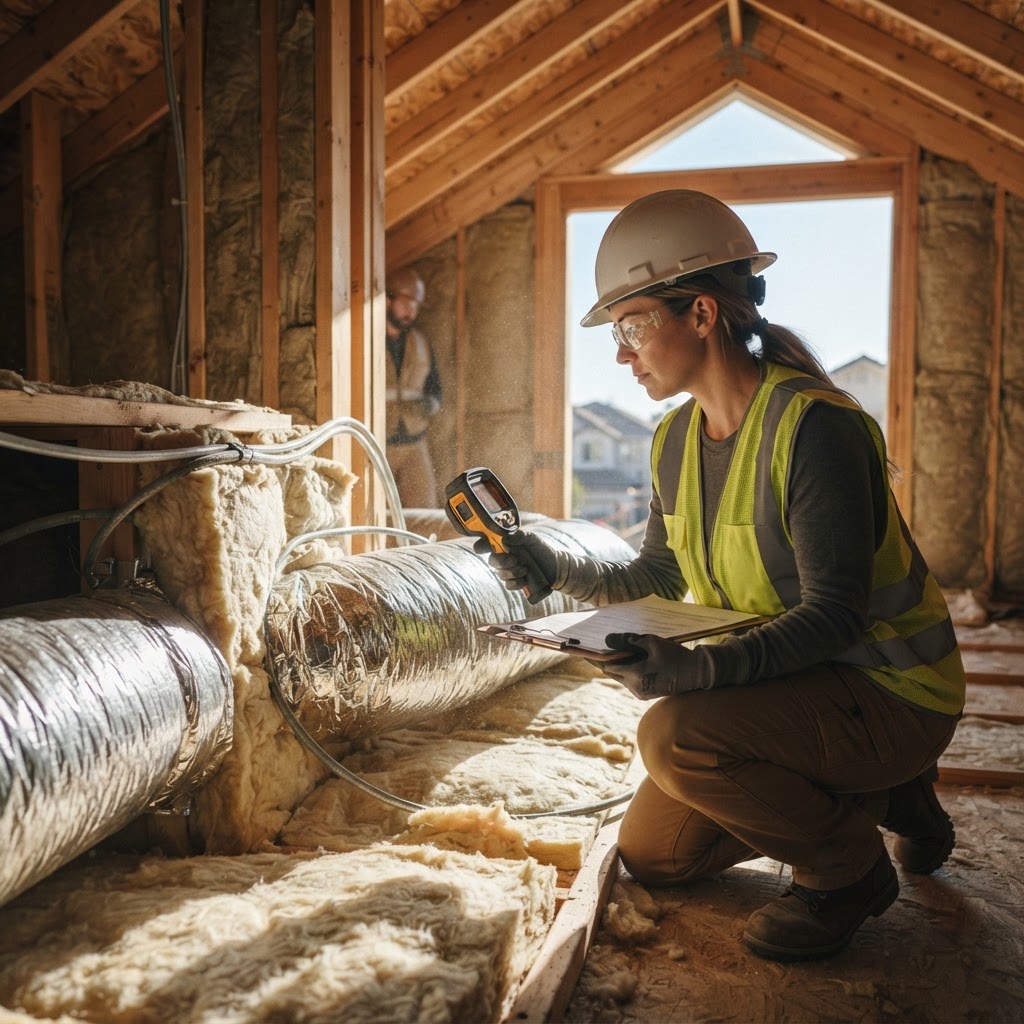
Don't let a failed insulation inspection stall your construction. Learn how to pass QII verification in 2026 and keep your project on schedule.
Understanding QII in the 2026 Energy Code
If you are a builder or homeowner in the Sacramento area managing a new construction or major addition, you have likely heard the term QII—Quality Insulation Installation. As an energy code compliance firm, we see projects stall every single month because a contractor forgot to schedule this critical third-party verification before the insulation was covered up by drywall.
QII is a mandatory field verification measure under the 2025 California Energy Code (effective January 2026). It is not a test you can 'fix' after the walls are closed. If the rater cannot see it, they cannot verify it, and if they cannot verify it, your permit cannot close. This guide explains how to prepare for QII, what our raters look for, and how to avoid the common pitfalls that lead to failed inspections.
Why QII is Required for Compliance
California’s energy modeling software, which generates your CF-1R compliance documentation, assumes a certain level of performance for your building envelope. Without QII, the software inherently 'penalizes' your building, assuming that the insulation will be compressed, gapped, or poorly fitted.
By including QII in your project design, your energy analyst is permitted to use the 'full' rated R-value of your insulation in the calculations. Without it, you might be forced to upgrade your windows, HVAC equipment, or water heaters just to reach the same level of compliance. Think of QII as a bridge that allows you to hit your efficiency targets without necessarily spending more on expensive hardware.
What Our Raters Inspect During QII
When our team arrives for a QII verification, we aren't just checking if there is insulation in the walls. We are conducting a rigorous, code-mandated evaluation of the installation quality. Our field raters follow the CF-3R-ENV-21 protocols to ensure:
- Full Cavity Fill: The insulation must fill the full depth and width of the wall or ceiling cavity. A batt that is too narrow creates thermal bridging at the studs.
- No Compression: If your insulation is smashed behind electrical boxes or plumbing pipes, it loses its R-value. We look for clean, precise cuts around these obstacles.
- Alignment with the Air Barrier: Insulation must be in continuous contact with the air barrier (the drywall or sheeting). If there is a gap between the insulation and the wall, conditioned air can circulate behind it, rendering the insulation nearly useless.
- Proper Sealing: We check that gaps around electrical outlets, lighting fixtures, and plumbing penetrations are properly sealed to prevent air leaks.
Field Observations: Common Causes of Failure
We see the same issues on job sites across Roseville, Folsom, and Elk Grove. These aren't intentional shortcuts; they are usually signs of a rushed install. Addressing these before we arrive saves you the cost of a return trip:
- The Electrical Box Trap: Installers often shove batts behind electrical boxes rather than cutting the insulation to fit around them. This causes the insulation to bulge into the room, leading to compression when the drywall is installed.
- Top Plate Voids: In attics, we frequently find that the insulation was pushed away from the top plates to allow for air flow, but the installer forgot to put an air-block (baffle) in place. This creates a direct thermal path from the attic to the ceiling.
- Disconnected Air Barriers: In rooms with dropped ceilings or complex framing, there are often spots where the insulation doesn't actually touch the ceiling plane. This is an immediate fail.
If you are preparing for your inspection, we suggest doing a 'pre-walkthrough' with your crew. Use a simple flashlight to look for light leaking through insulation gaps—if you see light, heat is moving through that spot too. If you are worried about your current progress, you can always get a fast quote from our team to perform a mock inspection before the drywallers arrive.
How to Schedule Your Inspection
Timing is the most important factor in a successful QII process. You must contact us after the insulation is installed but before the first sheet of drywall is hung. We recommend calling us as soon as your insulation contractor begins their work in Sacramento and surrounding areas.
Once we complete the inspection and the results are filed in the CHEERS registry, we will provide you with the necessary CF-3R documentation for your building department. If we find an issue, we will point it out clearly so your insulation contractor can fix it quickly. We often handle ECC testing in Sacramento for multiple phases of a project, so we can coordinate your QII verification alongside your duct leakage or blower door testing to minimize site visits.
Frequently Asked Questions
Can my insulation contractor perform their own QII verification?
No. The California Energy Commission requires QII to be performed by a third-party, independent, certified ECC (HERS) Rater. This ensures the inspection is unbiased and meets state-mandated quality standards.
What happens if I fail the QII inspection?
Failing isn't the end of your project. The rater will document the specific areas that require attention—such as gaps or compression—and provide a list of corrections. Once your installer fixes these points, we return for a re-inspection.
Is QII required for a small addition?
It depends on how your Title 24 compliance report was generated. If the compliance software utilized QII as a performance trade-off to meet efficiency requirements, it is a mandatory inspection for your permit. Check your CF-1R report to see if QII is listed as a required field verification.
How much time does a QII inspection usually take?
For a standard single-family home or major addition, a QII inspection typically takes between 1 to 3 hours depending on the size and complexity of the building. We recommend having a ladder available and ensuring all areas are accessible for the rater to view clearly.
Need Title 24 or ECC testing?
Fast scheduling across the Sacramento region and California.
Get a Fast Quote